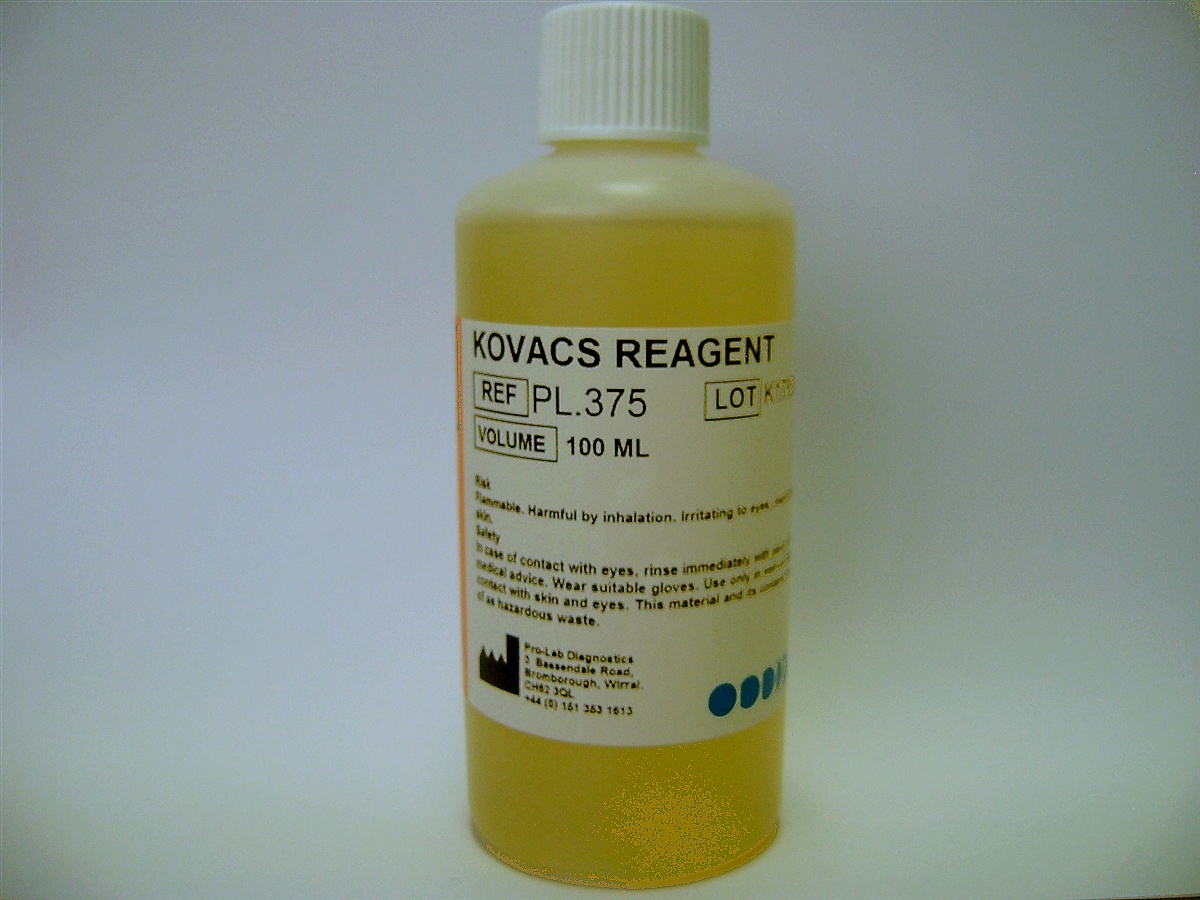
Kovacs' Reagent — Spot Indole Testing for Clinical Microbiology
100 ml · room-temperature storage (15–25°C) · both filter paper and swab methods validated per IFU Rev. 2023-12
QC organisms available from the same supplier.
For In Vitro Diagnostic Use Only | High Complexity | GHS Signal Word: DANGER
verifiedIVD — For In Vitro Diagnostic Use Only
|
check_circleCLSI M35-A2 Aligned
|High Complexity|IFU Rev. 2023-12|CE IVD
The Classic Kovacs Chemistry — Documented for Modern Accreditation
Nearly 100 years of established chemistry (Kovacs, 1928). CLSI M35-A2 aligned. Room-temperature storage. QC organisms from the same supplier.
device_thermostat
Room Temperature Storage
Stores at 15–25°C — no refrigerated shipping, no cold-pack receiving, no refrigerator space required.
IFU Rev. 2023-12
content_paste_go
Both Methods Validated
Filter paper method (Whatman No. 1) and direct colony swab method — both validated in the IFU. Hardy Z67 is not validated for colony spot testing.
IFU Rev. 2023-12, Procedure
policy
5% w/v p-DMAB — Exact CLSI M35-A2 Formulation
5 g of p-dimethylaminobenzaldehyde per 100 ml — the concentration specified in CLSI M35-A2 for spot indole testing.
CLSI M35-A2 + IFU Rev. 2023-12
hub
One-Vendor QC Ecosystem
IFU-specified QC organisms available from Pro-Lab Direct: PLD02 (E. coli ATCC 25922) and PLD04 (K. pneumoniae ATCC 13883).
IFU Rev. 2023-12, QC section
Tailored for Your Role
Select your role to see how PL.375 fits your specific workflow.
Lab Directors & Pathologists
CLSI M35-A2 Aligned Indole Testing — Documented for High Complexity Microbiology Laboratories
When CAP comes through, your documentation needs to show CLSI-aligned methodology, IFU-referenced QC organisms, and traceable lot validation. PL.375 delivers all three — room-temperature storage, both filter paper and swab methods validated, and QC organisms (PLD02/PLD04) available directly from Pro-Lab Direct.
task_altCLSI M35-A2 aligned: 5% w/v p-DMAB — the exact concentration specified for spot indole testing
task_altIFU-specified QC organisms: PLD02 (E. coli ATCC 25922) + PLD04 (K. pneumoniae ATCC 13883) — same-vendor sourcing
task_altCurrent IFU revision 2023-12 — up-to-date documentation for accreditation compliance
task_altHigh Complexity CLIA classification — documented for your quality records
Q: We're validated on Remel R21227. Does switching require full revalidation?
The active chemistry is the same — p-DMAB at 5% w/v (isoamyl alcohol carrier, HCl). Lot-to-lot validation using PL.375 IFU-specified QC organisms (PLD02/PLD04, both available from Pro-Lab Direct) follows the same procedure as your current lot change protocol.
Medical Laboratory Technologists
Spot Indole Testing That Works at the Bench — Filter Paper and Swab Methods, Both Validated
When you're running gram-negative workups, the indole test is as routine as the oxidase. You need a reagent that works the same way every time, doesn't require digging around the fridge, and gives you a clear red colour in under 3 minutes.
task_altFilter paper method: 1–2 drops on Whatman No. 1, smear colony growth, read in ≤3 minutes
task_altSwab method: 1–2 drops on cotton swab tip, touch to colony surface, read in ≤3 minutes
task_altCherry-red colour within 3 minutes — unambiguous visual endpoint
task_altRoom temperature storage (15–25°C) — grab it off the shelf, not out of the fridge
Q: What does an orange colour result mean?
Orange is a variable result — caused by skatole, a methylated precursor to indole. Repeat with a fresh colony. If the repeat is also orange, record as variable and proceed per your lab's SOP.
Lab Managers & Supervisors
100 ml Room-Temperature Reagent — Larger Safety Stock, No Cold-Chain Receiving
Room-temperature storage at 15–25°C, a 100 ml bottle that provides significantly larger safety stock than competitor 15–25 ml bottles, and direct ordering from pro-lab-direct.com.
task_alt100 ml vs. Remel 25 ml / Hardy 15 ml — 4–6× the volume, fewer reorders, less stockout risk
task_altRoom temperature storage: no cold-chain receiving, no refrigerator space allocation
task_alt$65.27 direct — order from pro-lab-direct.com or ask your distributor
task_altOne-vendor QC: reagent + QC organisms (PLD02, PLD04) in a single purchase order
Indole-Positive and Indole-Negative Organisms
Organisms by indole test result — cherry-red colour within 3 minutes (positive) or no colour change (negative). Source: IFU Rev. 2023-12; standard clinical microbiology references.
add_circle
Indole-Positive — Cherry-Red Colour Within 3 Minutes
Organism
Clinical Relevance
Escherichia coli
Primary UTI pathogen; IMViC QC positive control
Proteus vulgaris, P. morganii
UTI/wound — differentiate from indole-negative P. mirabilis
Klebsiella oxytoca
ESBL profile differs from K. pneumoniae
Morganella morganii
UTI and wound infection
Citrobacter koseri
Neonatal meningitis — differentiate from C. freundii
Aeromonas hydrophila
GI and wound infection
Vibrio spp.
Marine exposure; foodborne illness
Pasteurella multocida
Animal bite wound infection
do_not_disturb_on
Indole-Negative — No Colour Change (QC negative: K. pneumoniae ATCC 13883)
Organism
Clinical Relevance
Proteus mirabilis
Most common UTI Proteus; intrinsically resistant to nitrofurantoin
Klebsiella pneumoniae
Hospital-acquired infection; ESBL/KPC; QC negative control (PLD04)
Salmonella spp.
Foodborne; nationally notifiable pathogen
Shigella spp.
GI infection — most species indole-negative
Enterobacter spp.
Healthcare-associated infection
Serratia marcescens
HAI — especially in ICU
Citrobacter freundii
HAI — differentiate from indole-positive C. koseri
People Also Purchased
Complete your gram-negative identification workflow with Pro-Lab products.
PL.388 / PL.390
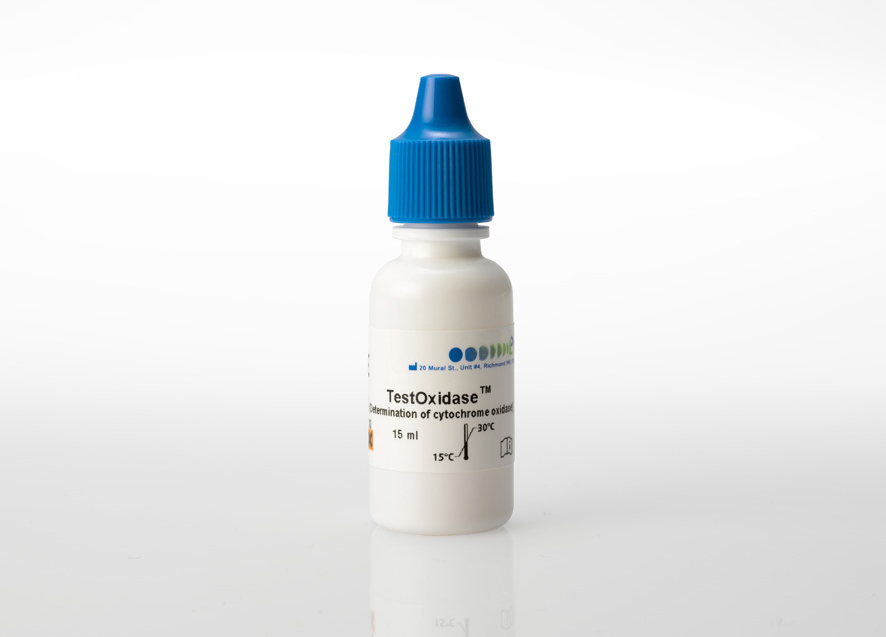
TestOxidase™ Reagent
Oxidase reagent — used in the same gram-negative identification workflow as the indole test (IMViC battery).
Side-by-side comparison based on published IFU data.
Feature
Pro-Lab PL.375
Remel R21227
Hardy Z67
Storage Temperature
15–25°C (room temp)
2–8°C (refrigerated)
[not confirmed]
Volume
100 ml
25 ml
15 ml
Colony Spot Test (filter paper)
✓ Validated (IFU)
Not confirmed
✗ Explicitly NOT for spot test (IFU)
Colony Swab Method
✓ Validated (IFU)
Not confirmed
✗ Tube/strip only
CLSI M35-A2 Alignment
✓ 5% w/v p-DMAB
Same chemistry
Not confirmed
QC Organisms — Same Vendor
✓ PLD02 + PLD04
Separate sourcing
Separate sourcing
Source: PL.375 IFU Rev. 2023-12; Remel R21227 IFU; Hardy Diagnostics Z67 IFU. All comparisons based on manufacturer-published IFU documents.
Frequently Asked Questions
Does Kovacs' Reagent require refrigeration?
expand_more
No — PL.375 stores at room temperature, 15–25°C, until the expiry date on the label. No cold-chain shipping, cold-pack receiving, or refrigerator storage is required. Remel R21227 requires 2–8°C refrigeration — a meaningful logistics difference.
Can I use PL.375 for the filter paper spot method directly on colonies?
expand_more
Yes — PL.375 validates both the filter paper method and the direct colony swab method in the IFU (Rev. 2023-12). Apply 1–2 drops to reagent-saturated filter paper or to a cotton swab tip; touch to colony; read within 3 minutes. Hardy Diagnostics Z67 explicitly states it is NOT for use in the filter paper spot test.
Is the Kovacs indole test validated per CLSI M35-A2?
expand_more
PL.375 contains 5 g of p-dimethylaminobenzaldehyde (p-DMAB) per 100 ml — a 5% w/v concentration. CLSI M35-A2 (Abbreviated Identification of Bacteria and Yeast) specifies 5% w/v p-DMAB as one of two sanctioned reagent formulations for the spot indole test.
What is the CLIA complexity classification?
expand_more
High Complexity — consistent with standard biochemical identification tests performed in accredited clinical microbiology laboratories. Document this classification in your CLIA/CAP quality records.
What QC organisms does the IFU specify?
expand_more
The IFU (Rev. 2023-12) specifies E. coli NCTC 12241 / ATCC 25922 as the positive control (PLD02 — produces red colour) and Klebsiella pneumoniae NCTC 9633 / ATCC 13883 as the negative control (PLD04 — no colour change). Both QC organisms are available directly from Pro-Lab Direct — order them with your reagent in the same purchase order.
What does an orange colour result mean?
expand_more
Orange is a variable result — typically caused by skatole, a methylated precursor to indole. Repeat the test using a fresh colony or a new culture. If the result is consistently orange, record as variable and proceed with supplementary identification per your lab's SOP.
Can I use PL.375 on MacConkey or EMB agar?
expand_more
No — glucose-containing media inhibit indole production and may cause false-negative results. Use non-glucose-containing media (blood agar, tryptic soy agar, or nutrient agar) for cultures to be tested with Kovacs' Reagent. This limitation is stated explicitly in IFU Rev. 2023-12.
Order Kovacs' Reagent PL.375
Ships direct from Pro-Lab — same or next business day
shopping_basket
Order Now
Single bottles and small quantities — direct online ordering
request_quote
Get a Volume Quote
Hospital systems, reference labs, and Net 30 accounts
support_agent
Book a Call
15 minutes with a Pro-Lab microbiology specialist — IFU, validation documentation, or ordering questions