✓ CE Marked IVD | DMACA Chemistry

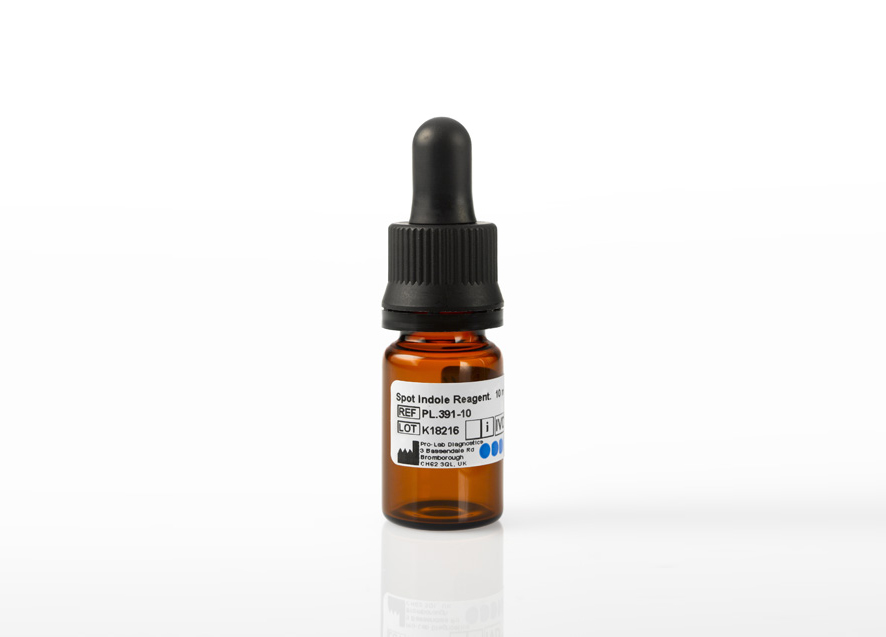
Spot Indole Reagent (PL.391-10) — DMACA Chemistry, CE Marked IVD

Validated in multilaboratory clinical studies: 99.1% E. coli ID accuracy (Peterson et al. 1982, PMID 6753569) and $3,000+ cost savings per 1,000 isolates with rapid spot test algorithm (York et al. 2000, PMID 10970389) — CE-marked DMACA chemistry with unambiguous blue in 3 minutes, ambient storage, and same-day direct shipping.

Ships same day from Round Rock, TX  ·  No cold chain required  ·  Ambient storage 15–25°C
CE Marked IVD
CLIA Moderate Complexity
DMACA Chemistry
Same-Day Shipping

Performance Data: What the Literature Shows

DMACA Chemistry — Proven Most Sensitive

In the definitive four-reagent comparison across 359 gram-negative rod strains, DMACA was "the most sensitive of those tested and provided results that were easiest to interpret." Blue is positive. Pink is negative. No ambiguous pink-to-red fade.

Miller & Wright, J Clin Microbiol 1982 (PMID 7040458)

99.1% Accuracy for Presumptive E. coli ID

In a prospective evaluation of 191 lactose-fermenting gram-negative rods, spot indole combined with morphological criteria achieved 99.1% accuracy for Escherichia coli identification — with significant cost and time savings versus a full biochemical panel.

Peterson et al., Am J Clin Pathol 1982 (PMID 6753569)

Ambient Storage — No Cold Chain Required

Store at 15–25°C in the original container, protected from light. Product is stable until the expiry date on the label. No refrigerator. No cold-pack shipping. No cold-chain failure risk.

IFU Rev. 2021-03, Storage section; Confirmed by Pro-Lab 2026-04-25

Same-Day Shipping Direct from Pro-Lab

Order direct at $43.37/10 mL with same-day shipping from Round Rock, TX. Also available through Fisher Scientific (22-286-249) and VWR (18973677). When your primary distributor is backordered, Pro-Lab ships the same day at a published price — no RFQ required.

Confirmed by Pro-Lab 2026-04-25; Fisher #22-286-249; VWR #18973677

Clinical Applications: E. coli, Proteus, and Gram-Negative ID

The spot indole reagent your gram-negative ID workflow depends on — CE marked, literature validated, and available direct when your primary supplier runs short.

The P. mirabilis vs. P. vulgaris distinction drives empiric antibiotic selection, and presumptive E. coli ID from the primary urine plate saves your lab a full biochemical panel on your highest-volume organism. Pro-Lab Spot Indole Reagent (PL.391-10) uses DMACA chemistry — proven more sensitive and easier to interpret than Kovacs (DMAB) in a four-reagent comparison across 359 strains. CE marked under the IVD Directive. Ambient storage confirmed. Direct backup supply at $43.37 when Fisher or VWR is backordered.

  • DMACA was "the most sensitive of those tested and provided results that were easiest to interpret" in a prospective four-reagent comparison across 359 gram-negative rod strains. (Miller & Wright, J Clin Microbiol 1982, PMID 7040458)
  • 99.1% accuracy for presumptive E. coli identification in 191 lactose-fermenting GNRs — with significant cost and time savings vs. full biochemical panel. (Peterson et al., Am J Clin Pathol 1982, PMID 6753569)
  • >99% predictive value for Proteus speciation when a single GNR strain is present — informing the P. mirabilis (ampicillin-susceptible) vs. P. vulgaris (ampicillin-resistant) antibiotic decision. (Bale et al., Am J Clin Pathol 1985, PMID 3966445)

No cold chain, no backorder panic, no reagent waste — the spot indole reagent that fits the way moderate-volume labs actually work.

Pro-Lab Spot Indole Reagent (PL.391-10) stores at ambient temperature (15–25°C) — nothing to refrigerate, nothing to cold-pack for shipping. The 10 mL vial is sized for labs running 5–15 spot indoles per day; a lab at that rate uses approximately 1 mL per week, so one bottle covers 10 weeks of routine use. Order direct at $43.37 with same-day shipping, or through your existing Fisher (22-286-249) or VWR (18973677) contracts.

  • Ambient storage 15–25°C per IFU Rev. 2021-03 — confirmed correct by Pro-Lab. No refrigeration or cold chain required in transit.
  • Same-day direct shipping from Round Rock, TX at a published price of $43.37/10 mL — no RFQ, no minimum order.
  • Fisher (22-286-249) and VWR (18973677) catalog listings active — routine PO purchasing on existing contracts continues unchanged.

Blue is positive. Pink is negative. In 3 minutes. No squinting, no arguing about whether that's pink or red.

Pro-Lab Spot Indole Reagent (PL.391-10) uses DMACA (p-dimethylaminocinnamaldehyde): blue is positive, pink is negative, read it in 3 minutes. The color is definitive. Published head-to-head comparison across 359 gram-negative strains confirmed DMACA gave "results that were easiest to interpret" of the four chemistries tested. Use it on blood agar, TSA, or nutrient agar — not MacConkey or EMB. Filter paper method or swab method. QC organisms are named in the IFU.

  • DMACA produces a distinct blue positive — the clearest, most unambiguous color change in spot indole chemistry. Miller & Wright 1982 confirmed results were "easiest to interpret" across 359 gram-negative rod strains.
  • Blue = positive (indole present). Pink = negative (no indole). Read within 3 minutes. No instrument required. Both filter paper and swab methods are supported.
  • QC organisms named in IFU: E. coli NCTC 12241/ATCC 25922 (positive, Pro-Lab PLD.02); N. gonorrhoeae NCTC 12700/ATCC 49226 (negative, Pro-Lab PLD.96).
Download IFU

Published price. Known catalog numbers. No cold-ship surcharge. No RFQ process required.

Pro-Lab Spot Indole Reagent PL.391-10 is $43.37 per 10 mL vial — published, fixed, no distributor quote required. Ships same-day from Pro-Lab Direct with no minimum order quantity and no cold-ship surcharge (ambient storage 15–25°C per IFU Rev. 2021-03). For purchasing through existing distributor contracts, PL.391-10 is in the Fisher Scientific catalog at #22-286-249 and VWR at #18973677. Hazmat class is UN1789, Class 8, Packing Group II — the same classification that applies to Remel R21245 and Hardy Z65.

  • Published direct price $43.37/10 mL — no RFQ required. Fisher (22-286-249) and VWR (18973677) catalog numbers are active for PO continuity on existing contracts.
  • No cold-ship surcharge. IFU Rev. 2021-03 confirms ambient storage at 15–25°C — no refrigerated packaging or carrier required.
  • UN1789, Class 8, PG II hazmat classification — the same as Remel R21245 and Hardy Z65. Hazmat cost is a category-level factor, not a Pro-Lab-specific disadvantage.

Related Products: Complete Your GNR Workflow

TestOxidase Reagent

PL.390  |  $51.10

Oxidase test: the step before Spot Indole in the gram-negative ID workflow. In the standard GNR rapid ID algorithm, oxidase testing (step 3) precedes spot indole (step 4). A negative oxidase result directs you to Enterobacteriaceae; spot indole then gives you the E. coli vs. P. mirabilis decision. One supplier, one order.

View TestOxidase PL.390 →

Pro-Loops Inoculating Loops

Pro-Lab Inoculating Loops

Required for filter paper method (see IFU). IFU Rev. 2021-03 names inoculating loops as a required material not included with the reagent. Pro-Lab inoculating loops are listed as related products for PL.391-10.

View Pro-Loops →

QC Organisms PLD.02 / PLD.96

PLD.02 & PLD.96

Required positive/negative controls per IFU QC protocol. PLD.02Escherichia coli NCTC 12241/ATCC 25922 — Positive control (expected blue). PLD.96Neisseria gonorrhoeae NCTC 12700/ATCC 49226 — Negative control (expected pink). IFU: "Internal quality control must be performed regularly on known reference material."

View QC Organisms →

Storage, Shelf Life, and Shipping — Full Specifications

Specification Detail
Catalog NumberPL.391-10 IFU Rev. 2021-03
Product NameSpot Indole Reagent IFU Rev. 2021-03
FormatLiquid, ready-to-use IFU Rev. 2021-03
Volume10 mL IFU Rev. 2021-03
Active Ingredientp-dimethylaminocinnamaldehyde (DMACA/PACA) + hydrochloric acid IFU Rev. 2021-03; SDS Rev. 3, 01/11/2023
ChemistryDMACA in HCl aqueous solution IFU Rev. 2021-03
Intended UseDetection of microorganisms that oxidise tryptophan into indole, pyruvic acid, and ammonia IFU Rev. 2021-03
IVD StatementFor In Vitro Diagnostic Use Only IFU Rev. 2021-03
CLIA ComplexityModerate Complexity IFU Rev. 2021-03
Specimen TypePure bacterial culture colony from non-glucose-containing, tryptophan-containing agar IFU Rev. 2021-03
Prohibited MediaMacConkey (MAC), eosin-methylene blue (EMB) — indicator dye carryover causes false positive results IFU Rev. 2021-03, Limitations
Result TimeBlue = positive (indole present); Pink = negative (no indole) — both within 3 minutes IFU Rev. 2021-03, Results
Instrument RequiredNone — visual interpretation IFU Rev. 2021-03
Controls IncludedNo — external QC organisms required IFU Rev. 2021-03
Controls RequiredPositive: E. coli ATCC 25922 (Pro-Lab PLD.02); Negative: N. gonorrhoeae ATCC 49226 (Pro-Lab PLD.96) IFU Rev. 2021-03, QC section
Storage15–25°C in original container. Protect from light. IFU Rev. 2021-03
Shelf LifeUntil expiry date on label (when stored per IFU) IFU Rev. 2021-03
Cold Chain RequiredNo IFU Rev. 2021-03; Confirmed by Pro-Lab 2026-04-25
Yield (Estimated)~500 tests per 10 mL vial (1–2 drops per test) Estimated from IFU Rev. 2021-03; confirm with Pro-Lab
CertificationsCE Marked (IVD Directive) IFU Rev. 2021-03
IFU Revision2021-03 (March 2021) IFU Rev. 2021-03
SDS Revision01/11/2023 (Rev. 3) SDS Rev. 3
GHS Signal WordDANGER SDS Rev. 3, Section 2
Hazmat ClassificationUN1789, Class 8, Packing Group II (Hydrochloric acid solution) SDS Rev. 3, Section 14
Distributor — Fisher#22-286-249 Fisher Scientific catalog
Distributor — VWR#18973677 VWR catalog
Direct Price$43.37 / 10 mL Confirmed by Pro-Lab 2026-04-25
ShippingSame-day from Round Rock, TX Confirmed by Pro-Lab 2026-04-25

Frequently Asked Questions

No. Per IFU Rev. 2021-03: "Spot indole reagent should be stored at 15–25°C in its original container. Protect from light." No cold chain is required for storage or shipping. The product is stable until the expiry date on the label under these conditions.
Blue indicates a positive result (indole present). Pink indicates a negative result (no indole). Both colors develop within 3 minutes. Do not interpret results after the 3-minute window. The DMACA chemistry produces a distinct blue compound that does not fade, making interpretation unambiguous.
No. MacConkey (MAC) agar and eosin-methylene blue (EMB) agar must not be used. Per IFU Rev. 2021-03: "MacConkey (MAC) or eosin-methylene blue agar (EMB) should not be used to culture organisms for the Indole test because they contain indicators which could result in carry over of color, resulting in false positive color interpretations." Use colonies grown on blood agar, TSA, or nutrient agar.
The intended use is detection of microorganisms that oxidise tryptophan to indole, pyruvic acid, and ammonia. Key indole-positive organisms (blue result) include: Escherichia coli, Proteus vulgaris, Morganella morganii, Klebsiella oxytoca, Pasteurella multocida, and certain Haemophilus influenzae biotypes. Key indole-negative organisms (pink result) include: Proteus mirabilis, Klebsiella pneumoniae, Enterobacter species, and Serratia marcescens. Note: some strains of Proteus vulgaris, Providencia, and Aeromonas may give false-negative reactions.
DMACA is more sensitive and produces results that are easier to interpret. In the definitive four-reagent comparison across 359 gram-negative rod strains, DMACA "was the most sensitive of those tested and provided results that were easiest to interpret" (Miller & Wright, J Clin Microbiol 1982, PMID 7040458). Kovacs/DMAB reagents produce a pink-to-red-violet reaction that can fade and is harder to call on certain media backgrounds. DMACA produces blue — unambiguous, non-fading, and higher spectral contrast.
Moderate Complexity. PL.391-10 is a manual biochemical spot test requiring trained personnel for interpretation. It is not CLIA-waived. Per IFU: "Only experienced personnel should carry out the interpretation of stained slides."
Yes. PL.391-10 is CE marked under the IVD Directive. CE marking is the applicable and recognized regulatory designation for this product category — FDA 510(k) clearance does not apply and is not claimed. Pro-Lab can provide the CE certificate, IFU Rev. 2021-03, and SDS documentation for your QMS file. Remel R21245 and BactiDrop are also CE marked. For other competitors, verify CE marking directly with the manufacturer before relying on it for regulatory documentation.
Proteus mirabilis is indole-negative (pink result) and is typically ampicillin-susceptible. Proteus vulgaris is indole-positive (blue result) and is typically ampicillin-resistant. This single bench result drives empiric antibiotic selection in swarming Proteus cases. In a prospective study of 172 consecutive swarming Proteus isolates, spot indole yielded >99% predictive value when only a single gram-negative rod strain was present — directly informing the ampicillin therapy decision. (Bale et al., Am J Clin Pathol 1985, PMID 3966445) Note: some P. vulgaris strains may give false-negative reactions.
Per IFU Rev. 2021-03: "Internal quality control of the spot indole reagent must be performed regularly on known reference material."

Positive control: Escherichia coli NCTC® 12241/ATCC® 25922 — expected blue result — available as Pro-Lab PLD.02
Negative control: Neisseria gonorrhoeae NCTC® 12700/ATCC® 49226 — expected pink result — available as Pro-Lab PLD.96

QC organisms are not included with PL.391-10 and must be purchased separately.

Quality Control and CLIA Compliance — IVD Regulatory Information

Intended Use

"For the detection of certain microorganisms that oxidise the amino acid Tryptophan into three major end products: indole, pyruvic acid and ammonia."

Source: IFU Rev. 2021-03, Intended Use  |  For In Vitro Diagnostic Use Only.

Test Principle

"The use of spot indole reagent detects the presence of indole which indicates tryptophan degradation and can be accomplished by the addition of certain aldehydes to form coloured end products. The presence of indole is detected by p-dimethylaminocinnamaldehyde which involves a chemical combination producing a distinct blue colour. The presence or absence of indole formation is used for bacterial identification."
(IFU Rev. 2021-03, Principle)

Specimen Requirements and Test Procedure

Method 1 — Filter Paper Method

  1. 1Dispense 1 to 2 drops of spot indole reagent onto a piece of filter paper (Whatman No. 1 or equivalent).
  2. 2Using an inoculating loop, smear the growth from an actively growing culture onto the reagent-saturated area of the filter paper.
  3. 3Observe the filter paper for the development of a blue colour within 3 minutes.

Method 2 — Swab Method

  1. 1Dispense 1 to 2 drops of spot indole reagent onto the tip of a cotton swab.
  2. 2Touch the tip of the saturated swab to the top of an actively growing colony on the surface of the agar medium.
  3. 3Observe the cotton tip for the development of a blue colour within 3 minutes.

Source: IFU Rev. 2021-03, Procedure sections. For In Vitro Diagnostic Use Only.

Quality Control Requirements

"Internal quality control of the spot indole reagent must be performed regularly on known reference material." (IFU Rev. 2021-03)

Control Type Organism ATCC/NCTC Pro-Lab SKU Expected Result
Positive Escherichia coli NCTC® 12241 / ATCC® 25922 PLD.02 Blue
Negative Neisseria gonorrhoeae NCTC® 12700 / ATCC® 49226 PLD.96 Pink

CAP IQCP: PL.391-10 is eligible for Individualized Quality Control Plan (IQCP) development per CAP requirements for commercially prepared microbiology products (CAP IQCP update: January 2025). Contact your CAP inspector or lab accreditation officer for IQCP guidance specific to your laboratory's risk assessment.

Limitations

All seven limitations verbatim from IFU Rev. 2021-03:

  1. "Only experienced personnel should carry out the interpretation of stained slides."
  2. "Colonies to be tested must be grown on non-glucose containing media. Glucose inhibits Indole Production."
  3. "MacConkey (MAC) or eosin-methylene blue agar (EMB) should not be used to culture organisms for the Indole test because they contain indicators which could result in carry over of color, resulting in false positive color interpretations."
  4. "Some strains of Proteus vulgaris, Providencia and Aeromonas exhibit a false negative reaction with the spot indole test."
  5. "Test colonies must be cultivated on media with adequate tryptophan content which is necessary for the indole reaction."
  6. "Media should be checked with known positive and negative control organisms."
  7. "Only pure cultures of organisms are to be tested. Weak false positive reactions may occur if the inoculum is a mixed culture of indole positive and negative organisms since adjacent colonies are likely to take up diffused indole."
Hazard Information — GHS / SDS
⚠ DANGER

GHS Signal Word per SDS Rev. 3, Section 2 (01/11/2023)

Skull & Crossbones
(H331)
Corrosion
(H314)
Exclamation
(H302/H332/H335)
H-Code Statement
H302Harmful if swallowed
H314Causes severe skin burns and eye damage
H331Toxic if inhaled
H332Harmful if inhaled
H335May cause respiratory irritation

Active Hazardous Ingredient: Hydrochloric acid (CAS 7647-01-0), 3–5% concentration

Required PPE:

👁 Tight-sealing safety goggles
🥊 Impervious gloves
🥥 Chemical-resistant apron

Disposal: Dispose per local regulations. Potential hazardous waste classification. Do not reuse empty containers.

Transport Classification: UN1789, Hydrochloric acid solution, Class 8 (Corrosive), Packing Group II — applies to IATA, IMDG, ADR, RID.

IFU-Cited References

Ordering Information and Distributor Catalog Numbers

$43.37 per 10 mL  |  Same-day shipping from Round Rock, TX  |  CE Marked IVD

Order Now

Ships same day from Round Rock, TX

Get a Quote

Bulk orders, hospital systems, and Net 30 accounts

Book a Call

15-minute intro with a Pro-Lab specialist — (512) 832-9145

Download IFU

Full instructions for use — PDF Rev. 2021-03

Download IFU (PDF)

For In Vitro Diagnostic Use Only. PL.391-10 — CE Marked IVD. Also available: Fisher Scientific #22-286-249  |  VWR #18973677