CE / IVD Certified — In Vitro Diagnostic Device

Immersion Oil DBP-Free 50ml — CE/IVD Certified for Clinical Microscopy

The only 50ml immersion oil that is explicitly DBP-free, CE/IVD marked, and suitable for fluorescence microscopy — at $39.99.

✓ 50ml dropper bottle
✓ Ships from Round Rock, TX
✓ ISO 13485 Certified Manufacturer
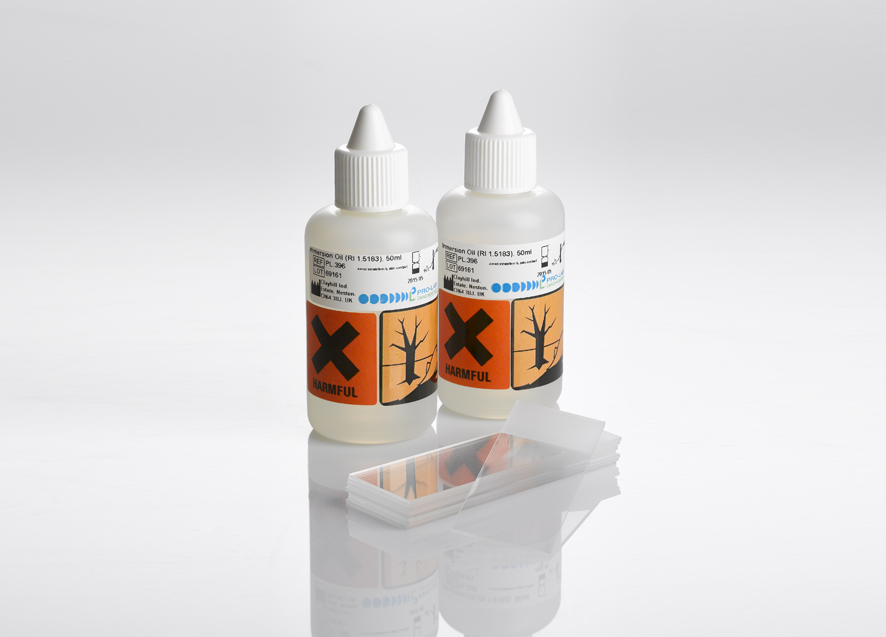
Pro-Lab Immersion Oil DBP-Free PL.396 — 50ml CE/IVD certified for clinical microscopy and fluorescence
✓ CE/IVD Marked — In Vitro Diagnostic Device
✓ Free from DBP (Dibutyl Phthalate)
✓ ISO 13485 Certified Manufacturer (NQA/ANAB)
▶ For In Vitro Diagnostic Use Only

Why Clinical Labs Choose PL.396

DBP-Free

No Reproductive Toxicant in Your Lab. PL.396 is formulated without Dibutyl Phthalate (DBP), a reproductive toxicant restricted under EU REACH Annex XVII and listed on California Prop 65 — protecting staff from chronic occupational exposure.

Source: IFU Rev. 2025 01

CE/IVD Certified

Documentation Ready for Your Accreditation File. CE marking for In Vitro Diagnostic use provides a documentable compliance record for ISO 15189, CAP, and CLIA laboratory accreditation — not available on research-grade or OEM oils.

Source: IFU Rev. 2025 01

🔬

Fluorescence-Compatible

One Oil for Routine and Fluorescence Protocols. No residual fluorescence — suitable for both conventional brightfield microscopy and fluorescence applications including AFB auramine-rhodamine staining.

Source: pro-lab.com product page

📈

Direct Savings

$12.81 Less Per Bottle Than Nikon Type N. At $39.99/50ml, PL.396 costs $12.81 less per bottle than Nikon Type N (MXA22203 at $52.80/50ml) — with more documented clinical attributes.

Source: spectraservices.com April 2026

Tailored for Your Role

One Oil for Routine and Fluorescence Work — DBP-Free, $39.99/50ml

Most clinical microbiology labs stock two immersion oils: a standard type for routine Gram stain and culture plate work, and a low-fluorescence type for AFB or immunofluorescence. Pro-Lab PL.396 covers both. It produces no residual fluorescence, is CE/IVD-marked for documentation compliance, and is formulated without DBP — the phthalate reproductive toxicant restricted under EU REACH Annex XVII.

  • DBP-free — eliminates Reproductive Toxicant Cat. 1B from lab environment (IFU Rev. 2025 01)
  • CE/IVD marked — documentable for accreditation files (IFU Rev. 2025 01)
  • $12.81 less per bottle than Nikon Type N (spectraservices.com April 2026)
Common questions:

We already use Sigma immersion oil — it's cheaper. Why switch?

Sigma 56822 is a research-grade product with no IVD-CE mark and no DBP-free claim. For a clinical microbiology lab, PL.396 provides IVD documentation for your accreditation file and eliminates a REACH-restricted chemical from your bench — at a $17.41/bottle premium over Sigma.

We have all-Nikon scopes — shouldn't we use Nikon oil?

PL.396 and Nikon Type N both target the same refractive index for standard clinical microscopy work. PL.396 is $12.81 less per bottle, DBP-free, and CE/IVD marked. For all-Nikon labs running fluorescence assays, PL.396 covers both routine and fluorescence in one bottle.

IVD-Certified, DBP-Free — Documentation Ready for CAP and ISO 15189 Files

Accreditation auditors increasingly scrutinize reagent and consumable documentation — not just test performance. IVD-CE marking on consumables like immersion oil provides a documentable compliance record that research-grade alternatives cannot. PL.396 is CE/IVD-marked, DBP-free per REACH Annex XVII, and produced by an ISO 13485-certified manufacturer.

  • CE/IVD marked — accreditation documentation available (IFU Rev. 2025 01)
  • DBP-free — eliminates REACH SVHC from lab environment (IFU Rev. 2025 01; ECHA REACH Annex XVII)
  • ISO 13485 certified manufacturer — NQA/ANAB (pro-lab-direct.com)

Is DBP in immersion oil actually a compliance issue?

In the US, there is currently no mandate. In EU-aligned and ISO 15189 environments, SVHC substitution is a best practice increasingly verified in audits. DBP is EU REACH Annex XVII restricted (July 2020), a Reproductive Toxicant Cat. 1B, and a California Prop 65 listed substance. PL.396 eliminates this exposure with no performance tradeoff.

Is one more vendor worth it just for immersion oil?

Pro-Lab Diagnostics USA is already in your vendor file for other IVD products on pro-lab-direct.com. Adding PL.396 is a line-item add under an existing relationship, not a new vendor qualification.

One Oil for Your Whole Scope — No Background Signal on Fluorescence

If you run AFB auramine-rhodamine or any immunofluorescence assay, standard immersion oils can introduce autofluorescence background that shows up as noise in your field. Pro-Lab PL.396 produces no residual fluorescence — the same bottle you use for routine Gram stain 1000x work is suitable for your fluorescence protocols.

  • DBP-free — eliminates reproductive toxicant from repeated daily skin-contact exposure (IFU Rev. 2025 01)
  • Compatible with all major microscope brands (RI matched to glass — IFU Rev. 2025 01)
  • 4-step procedure: apply, move objective into contact, fine-focus, clean after use (IFU Rev. 2025 01)

How do I clean the oil from the objective lens?

After use, clean the oil from the lens using a soft tissue. (IFU Rev. 2025 01, Procedure Step 4)

Does the oil need to be at a specific temperature for best results?

PL.396 performs optimally at 23°C. It may be stored between 15°C and 25°C and will remain stable, but image clarity is best when the oil is at 23°C room temperature. (IFU Rev. 2025 01)

People Also Purchased

Technical Specifications — PL.396

Parameter Value Source
Catalog numberPL.396IFU Rev. 2025 01
Volume50 ml (dropper bottle)IFU Rev. 2025 01
Intended useFor use in microscopic examination of prepared slides from clinical specimensIFU Rev. 2025 01
DBP-freeYes — Free from Dibutyl Phthalate (DBP); non-teratogenicIFU Rev. 2025 01
Refractive indexSame as glass microscopy slides; optimum at 23°CIFU Rev. 2025 01
Storage temperature15–25°C in original containerIFU Rev. 2025 01
Optimum use temperature23°CIFU Rev. 2025 01
Shelf lifeUntil expiry date on labelIFU Rev. 2025 01
CE/IVD markingCE marked — In Vitro Diagnostic medical deviceIFU Rev. 2025 01
EC REPAdvena Ltd., Tower Business Centre, Tower Street, Swatar, BKR 4013, MaltaIFU Rev. 2025 01
Hazard statementH413 — May cause long lasting harmful effects to aquatic lifeIFU Rev. 2025 01
Precautionary statementsP273 — Avoid release to the environment; P501 — Dispose of contents/container per local regulationsIFU Rev. 2025 01
ISO certificationISO 13485 Certified Manufacturer — NQA/ANABpro-lab-direct.com
Price$39.99 / 50mlpro-lab-direct.com

Full IFU: IFU Rev. 2025 01 (PDF)

Compare: Pro-Lab vs. Sigma vs. Nikon

Pro-Lab PL.396 Sigma 56822 Nikon Type N
Price / 50ml$39.99~$22.58$52.80
DBP-free✓ Confirmed (IFU)✗ Not claimed✗ Not claimed
CE/IVD marked✓ Yes✗ No✗ No
Fluorescence-suitable✓ Stated✗ Not stated✗ Not stated

Sources: Pro-Lab IFU Rev. 2025 01; Sigma 56822 product page; Nikon Type N pricing — spectraservices.com April 2026; scientificlabs.co.uk April 2026.

Procedure (from IFU Rev. 2025 01)

  1. 1 Focus on the specimen using a dry objective lens (×40), making sure that the specimen is central in the view.
  2. 2 Move the dry objective to one side and place a drop of Immersion Oil on top of the specimen. Move the oil immersion lens into place, ensuring that it makes contact with the oil drop.
  3. 3 View the specimen, making any fine adjustments to obtain the best image.
  4. 4 After use it is important to clean the oil from the lens using a soft tissue.

Limitations (from IFU Rev. 2025 01)

  • Only experienced personnel should carry out the interpretation of stained slides.
  • Read prepared slides as soon as possible after staining. Failure to do so may affect the results.
  • Immersion Oil has an optimum refractive index at 23°C. While the product will remain stable if stored between 15°C and 25°C, samples will be visualised most clearly if the oil is stored at 23°C.
  • Microbial contamination may decrease the accuracy of the staining.
  • Do not use beyond the stated expiration date.

QC Requirement

Internal quality control of the Immersion Oil must be performed regularly on known reference material. The Pro-Slide™ range of quality control slides is available from Pro-Lab for this purpose. (IFU Rev. 2025 01)

Frequently Asked Questions

Is Pro-Lab PL.396 immersion oil DBP-free?

Yes. PL.396 is explicitly formulated without Dibutyl Phthalate (DBP) and is described in the IFU as non-teratogenic. DBP is restricted under EU REACH Annex XVII (effective July 2020) as a Reproductive Toxicant Category 1B. PL.396 eliminates this occupational hazard. (Source: IFU Rev. 2025 01; ECHA REACH Annex XVII)

Is PL.396 CE-marked for IVD use?

Yes. Pro-Lab PL.396 carries CE marking as an In Vitro Diagnostic medical device (IVD symbol present on IFU Rev. 2025 01). CE/IVD documentation is available for laboratory accreditation files including ISO 15189, CAP, and CLIA. (Source: IFU Rev. 2025 01)

What temperature should the immersion oil be stored at?

Store PL.396 in its original container at 15–25°C. For best image clarity, allow the oil to reach 23°C before use — this is the temperature at which the refractive index is optimised. (Source: IFU Rev. 2025 01)

How do I use PL.396 immersion oil?

(1) Focus on the specimen using a dry objective lens (×40), keeping the specimen centred in the view. (2) Move the dry objective aside and place a drop of Immersion Oil on top of the specimen; move the oil immersion lens into place ensuring contact with the oil drop. (3) View the specimen and make fine adjustments for the best image. (4) After use, clean the oil from the lens using a soft tissue. (Source: IFU Rev. 2025 01, Procedure section)

Is this oil compatible with fluorescence microscopy?

PL.396 produces no residual fluorescence and is stated as suitable for both light and fluorescence microscopy. For fluorescence applications (e.g., AFB auramine-rhodamine staining), confirm oil is at 23°C for optimal refractive index performance. (Source: pro-lab.com product page)

When should PL.396 NOT be used?

PL.396 should not be used beyond the expiry date printed on the product label. Slides should be read as soon as possible after staining — delay may affect results. Only experienced personnel should carry out interpretation of stained slides. Microbial contamination may decrease accuracy. Dispose of contents/container per local regulations. (Source: IFU Rev. 2025 01)

How does PL.396 compare in price to Nikon Type N immersion oil?

PL.396 (50ml, $39.99) is $12.81 less per bottle than Nikon Type N MXA22203 (50ml, $52.80). PL.396 is additionally DBP-free and CE/IVD marked — attributes Nikon Type N does not carry. (Source: Nikon Type N pricing — spectraservices.com April 2026; Pro-Lab pricing — pro-lab-direct.com)

Does PL.396 require quality control?

Yes. Internal quality control must be performed regularly on known reference material. The Pro-Slide™ range of quality control slides is available from Pro-Lab for this purpose. (Source: IFU Rev. 2025 01, Quality Control section)

Ready to Order?

CE/IVD documentation available. Ships from Round Rock, TX. ISO 13485 certified manufacturer.