Five bottle sizes (100ml–2L), FDA-registered CE-marked IVD quality, and in-house manufacturing since 1989 — covering Gram, ZN acid-fast, Auramine, Cryptosporidium, and 55+ specialty stains from a single supplier.
PLACEHOLDER — Request testimonials from top Pro-Lab UK NHS accounts — Day 1 action per marketing-plan.md §1.7
[PLACEHOLDER — request from top Pro-Lab UK NHS lab account. Suggest Mark Reed identify 1–2 NHS lab managers for testimonial.]
[Name, Title]
[NHS Trust or US Lab Name]
[PLACEHOLDER — request from Pro-Lab US existing customer who orders non-stain products.]
[Name, Title]
[Institution]
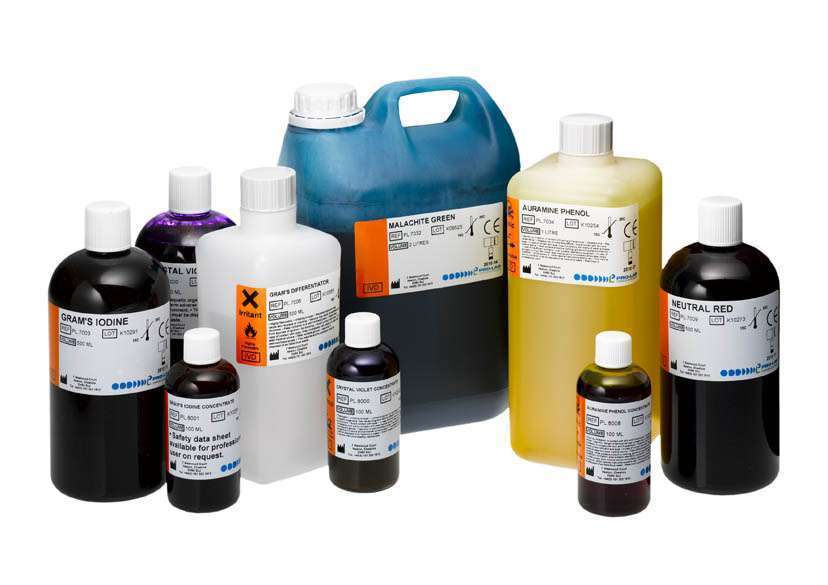
Right-size every reagent order. Crystal Violet, Gram's Iodine, Differentiator, and Safranin in 100ml, 250ml, 500ml, 1L, and 2L — order exactly what your lab uses before the next expiry date.
IFU Rev. 2025 01
Same formula, every lot, since 1989. Every batch produced at a single UK facility with the same raw materials and filtration protocols — no third-party repackaging, no contract manufacturer changes, consistent lot-to-lot chemistry.
Pro-Lab Diagnostics manufacturer statement
FDA registered for US distribution. CE-marked under the EU IVD Directive. Each product ships with a complete IFU specifying QC organisms, acceptance criteria, and GHS hazard classifications.
IFU Rev. 2025 01; FDA Establishment Reg. No. 1318862 — Pro-Lab USA (Georgetown, TX)
Replace multiple stain suppliers with one account: Gram, ZN acid-fast, Kinyoun, Auramine fluorescent, Cryptosporidium kits, Acridine Orange, Lugol's Iodine, Malachite Green, and 55+ specialty stains.
Pro-Lab manufacturer catalog
Lab directors need more than a stain that works today — they need a supplier whose documentation holds up under audit. Pro-Stains™ carries CE marking under the EU IVD Directive, with a complete IFU specifying QC organisms, acceptance criteria, storage conditions, and GHS safety classifications. FDA registered for US distribution.
Q: Is Pro-Stains™ FDA registered for US clinical lab use?
Yes — Pro-Stains™ is FDA registered for US distribution and CE-marked under the EU IVD Directive. Full regulatory documentation is available including IFU with QC organisms, acceptance criteria, and GHS safety classifications.
Q: How do I validate Pro-Stains™ against my existing CLIA Gram stain protocol?
The IFU (Rev 2025 01) provides QC organisms with expected morphological acceptance criteria. Most labs complete a reagent change validation in a single shift by running both products on the same specimens and confirming equivalent morphological outcomes.
Every lab manager has thrown away half a 2-liter bottle of Crystal Violet because the batch expired before the team could use it. Pro-Stains™ offers five bottle sizes per reagent — 100ml for low-volume specialty use, 250ml for smaller labs, 500ml for steady-throughput labs, 1L and 2L for high-volume operations.
Q: What bottle size should I order for a low-volume lab?
For labs performing fewer than 50 Gram stains per week, 100ml or 250ml bottles keep reagents fresh and reduce waste. Crystal Violet PL.8000 (100ml) and PL.7000 (500ml); Gram's Iodine PL.8001 (100ml) and PL.7003 (500ml) — all other reagents available in the same size range.
Q: Can I consolidate all my staining reagents — Gram, ZN, and specialty — under one account?
Yes. Pro-Stains™ covers 130+ SKUs including Gram staining reagents, ZN and Kinyoun acid-fast stains, Auramine fluorescent stains, Cryptosporidium kits, Acridine Orange, Lugol's Iodine, Malachite Green, Methylene Blue, Lactophenol Cotton Blue, and 55+ additional specialty stains.
When you pick up a bottle of Crystal Violet in the middle of a Gram stain run, it needs to perform exactly as expected. Pro-Stains™ is produced at a dedicated in-house facility using the same raw materials and filtration protocols on every batch. The right-sized bottle means fresh reagent at every use — not stain that has been open for eight months slowly oxidizing at the bench.
Q: What are the expected QC results for Pro-Stains™ Gram staining reagents?
Per the IFU (Rev 2025 01): Staphylococcus aureus ATCC® 25923 should stain blue-purple (Gram-positive cocci); Escherichia coli ATCC® 25922 should stain pink-red (Gram-negative rods). Pro-Slide™ Gram Stain Control (PL.4961) is the named slide control for routine QC.
Q: Do Pro-Stains™ reagents require refrigeration?
No. Pro-Stains™ Gram staining and ZN acid-fast staining solutions are stored at 15–25°C in their original containers and are stable until the expiry date on the label. No cold chain management required.
Procurement teams managing laboratory reagents know the cost of supplier sprawl — multiple accounts, multiple PO numbers, multiple minimum order thresholds. Pro-Stains™ consolidates over 130 clinical microbiology staining SKUs under a single Pro-Lab Direct account with direct, transparent pricing.
Q: How do I order Pro-Stains™ in the United States?
Pro-Stains™ is available for direct purchase through pro-lab-direct.com. Select your stain category and bottle size, then submit a quote request or add to cart. Contact us for volume pricing and Net 30 terms for qualifying accounts.
Q: Is volume pricing available?
Yes — contact Pro-Lab Direct for volume pricing on orders above standard quantities, multi-site health system accounts, and Net 30 billing arrangements for qualifying organizations.
Infection preventionists rely on accurate pathogen identification for HAI surveillance, NHSN reporting, and antimicrobial stewardship decisions. Published evidence demonstrates that Gram staining quality directly affects diagnostic accuracy for staphylococcal hospital-acquired pneumonia, ventilator-associated pneumonia, and septic arthritis pathogen identification.
Q: How does gram stain reagent quality affect HAI surveillance?
When HAI surveillance data relies on Gram stain results, reagent lot-to-lot consistency directly affects the reliability of the pathogen data your program acts on. Gram stain diagnostic accuracy for staphylococcal pneumonia and septic arthritis identification is documented as dependent on staining technique and reagent quality (PMID 32822880; PMID 40330095).
Q: What gram stain evidence exists for hospital-acquired pneumonia diagnosis?
A systematic review and meta-analysis (Ranzani OT et al., Clin Microbiol Infect. 2020;26(11):1456–1464; PMID 32822880) demonstrates diagnostic accuracy of Gram stain for staphylococcal hospital-acquired and ventilator-associated pneumonia, with positive predictive value supporting targeted therapy decisions for HAP/VAP.
Complete your staining workflow with IFU-specified controls and accessories.
PL.4961
IFU-specified QC slide for Gram staining — S. aureus (Gram-positive) and E. coli (Gram-negative) on a single prepared slide.
View ProductPL.4960
IFU-specified QC slide for ZN acid-fast staining — M. scrofulaceum positive control on prepared slide.
View ProductPL.396
Required for 1000× microscopy in Gram stain and ZN acid-fast workflows; DBP-free formulation for safer laboratory use.
View ProductAll values from published IFU documents — IFU-2025-01-GramStaining.pdf (Rev 2025 01) and IFU-2021-AcidFastZN.pdf
| Specification | Gram Staining Reagents | ZN Acid-Fast Staining Reagents |
|---|---|---|
| CLIA Complexity | High Complexity | High Complexity |
| Intended Use | For use in the Gram staining method for the rapid differentiation of Gram-positive and Gram-negative bacteria in prepared slides from clinical specimens. | For use in staining smears prepared from clinical specimens suspected of containing Mycobacteria. |
| Specimen Type | Prepared slides from clinical specimens | Clinical specimens suspected of containing Mycobacteria |
| Result Time | ~3–5 minutes (manual procedure) | ~10 minutes (manual procedure) |
| Bottle Sizes | 100ml, 250ml, 500ml, 1L, 2L | 100ml, 250ml, 500ml, 1L, 2L |
| Storage | 15–25°C in original containers — no refrigeration required | 15–25°C in original containers — no refrigeration required |
| Shelf Life | Until expiry date shown on label | Until expiry date shown on label |
| QC Organisms (Positive) | Staphylococcus aureus ATCC® 25923 (blue-purple cocci) | Mycobacterium scrofulaceum ATCC® 19981 |
| QC Organisms (Negative) | Escherichia coli ATCC® 25922 (pink rods) | Escherichia coli ATCC® 25922 |
| Slide Control | Pro-Slide™ Gram Stain Control PL.4961 (sold separately) | Pro-Slide™ Acid-Fast Stain Control PL.4960 (sold separately) |
| Regulatory Status | FDA Registered (Reg. No. 1318862 — Pro-Lab USA (Georgetown, TX)); CE-Marked IVD (EU IVD Directive) | FDA Registered (Reg. No. 1318862 — Pro-Lab USA (Georgetown, TX)); CE-Marked IVD (EU IVD Directive) |
| Key Limitation | Only experienced personnel should interpret stained slides. Read prepared slides as soon as possible after staining. | Positive acid-fast staining provides presumptive evidence only of Mycobacteria — culture confirmation is required. |
| Performance Data | Performance data on file — contact Pro-Lab Direct for method validation data and lot release documentation. Published independent performance data: Del Rio-Pertuz G et al. BMC Infect Dis. 2019;19(1):403. PMID: 31077143. | |
⚠ Hazard Warning — Crystal Violet (All Sizes)
Signal word: DANGER. H350: May cause cancer. H412: Harmful to aquatic life with long-lasting effects. Always wear chemical-resistant gloves and eye protection. Dispose of contents and container per local regulations — do not pour down drain. Refer to current SDS for complete hazard information and PPE requirements.
⚠ GHS08 Health Hazard ⚓ GHS09 Aquatic Env. Hazard Crystal Violet H350 applies to all concentrations including RTU formulations. This disclosure is mandatory — not minimized. Refer to current SDS for full GHS label.
Gram Staining — Intended Use (verbatim IFU)
"For use in the Gram staining method for the rapid differentiation of Gram-positive and Gram-negative bacteria in prepared slides from clinical specimens."
IFU-2025-01-GramStaining.pdf §Intended Use — Rev 2025 01
Gram Staining — Principle
Gram-positive bacteria have a thicker peptidoglycan cell wall that retains the primary stain (Crystal Violet), appearing blue-purple after staining. Gram-negative bacteria have a thinner peptidoglycan layer that allows the primary stain to be removed by the differentiator, leaving cells stained pink-red by the counterstain.
Gram Staining Procedure (7 steps)
IFU-2025-01-GramStaining.pdf §Procedure — verbatim step structure
ZN Acid-Fast Staining — Intended Use (verbatim IFU)
"For use in staining smears prepared from clinical specimens suspected of containing Mycobacteria."
IFU-2021-AcidFastZN.pdf §Intended Use
Limitations (from IFU — do not omit)
Additional Hazard Information
Gram's Differentiator (50/50 IMS/Acetone): Signal word DANGER — H226 (flammable liquid), H319 (eye irritation), H331 (toxic if inhaled), H336 (drowsiness/dizziness). Gram's Iodine: Not classified hazardous under GHS. PPE required for all staining procedures: chemical-resistant gloves, eye protection, lab coat.
SDS Revision Date
SDS documents for Pro-Stains™ reagents carry a 2019 revision date. US customers: confirm current SDS documents meet OSHA HazCom 2012 (29 CFR 1910.1200) 16-section GHS format requirements. Contact Pro-Lab Direct for current SDS.
CAP IQCP Eligibility
Pro-Stains™ staining reagents are eligible for an Individualized Quality Control Plan (IQCP) under the CAP Microbiology Checklist. Contact Pro-Lab Direct for QC risk assessment documentation to support your IQCP submission.
For current SDS, IFU, and regulatory documentation, contact Pro-Lab Direct. Documents are provided at no charge for CLIA validation purposes.
No distributor. No minimum order. Ships from UK manufacturing — CE-marked IVD, FDA registered.